 85b7a0b136
* feat: add AI request details feature with latency tracking

Add comprehensive request history and debugging capability to the Usage dashboard:

**Storage Layer** (usageDb.js):
- Add saveRequestDetail() for storing full request/response details
- Implement FIFO queue with 1000-record limit in request-details.json
- Auto-sanitize sensitive headers (authorization, api-key, cookie, token)
- Add getRequestDetails() with pagination and filtering support
- Add getRequestDetailById() for single record lookup

**Pipeline Integration** (chatCore.js):
- Track request start time and calculate total latency
- Record TTFT (Time To First Token) and total latency for all requests
- Capture full request details (messages, model, parameters)
- Save response content for non-streaming, mark streaming responses
- Handle error cases with detailed error information
- Async non-blocking saves to avoid impacting request performance

**API Layer** (/api/usage/request-details):
- GET endpoint with pagination (page, pageSize: 1-100)
- Filter by provider, model, connectionId, status, date range
- Returns { details: [...], pagination: {...} } format

**UI Components**:
- Drawer.js: Right slide-out panel with backdrop blur and ESC close
- Pagination.js: Full pagination with page size selector (10/20/50)
- RequestDetailsTab.js: Complete table view with filters and detail drawer

**Dashboard Integration**:
- Add "Details" tab to Usage page (4th tab after Overview/Logger/Limits)
- Table columns: Timestamp, Model, Provider, Input Tokens, Output Tokens, Latency (TTFT/Total), Action
- Provider filter dropdown (9 providers supported)
- Date range filters (start/end datetime)
- Click "Detail" button to view full request/response JSON in slide-out drawer

**Features**:
- Real-time latency monitoring (TTFT & Total)
- Complete request/response inspection for debugging
- Filterable and searchable request history
- Responsive design with mobile-friendly filters
- Data security with automatic header sanitization
- Performance: async saves don't block request pipeline

**Files Created/Modified**:
- src/lib/usageDb.js (modified)
- open-sse/handlers/chatCore.js (modified)
- src/app/api/usage/request-details/route.js (new)
- src/shared/components/Drawer.js (new)
- src/shared/components/Pagination.js (new)
- src/app/(dashboard)/dashboard/usage/components/RequestDetailsTab.js (new)
- src/app/(dashboard)/dashboard/usage/page.js (modified)

Closes: AI Observability Dashboard feature

* feat: enhance request details with full config and streaming content capture

Improve Request Details feature to capture comprehensive request parameters
and actual streaming response content:

**Request Configuration Enhancement** (chatCore.js):
- Add extractRequestConfig() helper function to capture all request parameters
- Include temperature controls: temperature, top_p, top_k
- Include token limits: max_tokens, max_completion_tokens
- Include thinking/reasoning modes: thinking, reasoning, enable_thinking
- Include OpenAI parameters: presence_penalty, frequency_penalty, seed, stop,
  tools, tool_choice, response_format, n, logprobs, top_logprobs, logit_bias,
  user, parallel_tool_calls, prediction, store, metadata
- Apply to all request types: non-streaming, streaming, and error cases

**Streaming Content Capture** (chatCore.js & stream.js):
- Add onStreamComplete callback mechanism to stream processors
- Accumulate content from all formats: OpenAI, Claude, Gemini
- Track content from delta.content, delta.reasoning_content, delta.text,
  delta.thinking, and Gemini content.parts
- Save initial record with "[Streaming in progress...]" marker
- Update record with actual content when stream completes
- Include usage tokens when available from stream

**Files Modified**:
- open-sse/handlers/chatCore.js - extractRequestConfig() + streaming capture
- open-sse/utils/stream.js - onStreamComplete callback + content accumulation

**Benefits**:
- View complete request configuration in Request Details (thinking mode, etc.)
- See actual streaming response content instead of placeholder
- Better debugging and observability for AI requests

Refs: #request-details-enhancement

* feat: separate thinking/reasoning content from response content

Improve Request Details to display thinking process separately from final response:

**Backend Changes**:
- stream.js: Capture content and thinking separately in streaming mode
  - Add accumulatedThinking variable alongside accumulatedContent
  - Route delta.content to content, delta.reasoning_content to thinking
  - Support OpenAI (reasoning_content), Claude (thinking), Gemini (part.thought)
  - Update onStreamComplete callback to return { content, thinking } object

- chatCore.js: Update response structure to include thinking field
  - Non-streaming: Extract thinking from reasoning_content field
  - Streaming: Receive { content, thinking } from stream callback
  - Error responses: Include thinking: null
  - Initial streaming save: Include thinking: null

**Frontend Changes**:
- RequestDetailsTab.js: Display thinking and content in separate sections
  - Add amber/yellow themed "Thinking Process" section with psychology icon
  - Show "Final Response" label when thinking is present
  - Use distinct visual styling for thinking (amber bg) vs content (gray bg)
  - Only show thinking section when thinking content exists

**Benefits**:
- Users can clearly see model's reasoning process vs final answer
- Better debugging for models with thinking capabilities (Claude, o1, etc.)
- Visual distinction makes it easy to identify thinking vs response

Refs: #thinking-content-separation

* fix: map Claude thinking to reasoning_content field

Fix Claude thinking content to be properly captured as reasoning_content
instead of regular content, enabling separate display in Request Details:

**Changes**:
- claude-to-openai.js: Use reasoning_content field for thinking blocks
  - thinking start: send { reasoning_content: "" } instead of { content: "```\n```" }
  - thinking delta: map to reasoning_content instead of content
  - thinking stop: send { reasoning_content: "" } instead of { content: "```\n```" }

**Why This Matters**:
- Previously Claude thinking was sent as `content` field, mixed with actual response
- Now thinking uses `reasoning_content` field, matching OpenAI's o1 format
- stream.js can now properly route thinking to accumulatedThinking variable
- Request Details UI will show Claude thinking in separate "Thinking Process" section

**Supported Thinking Formats**:
- OpenAI: delta.reasoning_content → thinking
- Claude: delta.thinking → reasoning_content (now fixed)
- Gemini: part.thought === true → thinking

Refs: #claude-thinking-fix

* feat(observability): capture and display full 4-layer request chain

Capture complete request/response chain in AI Request Details:
- Add providerRequest field (translated request sent to provider)
- Add providerResponse field (raw provider response, streaming indicator)
- Update chatCore.js at all 5 saveRequestDetail() call sites
- Reorganize UI into 4 collapsible sections with Material icons
- Preserve backward compatibility for old records
- Add distinct styling for streaming indicator

* fix(observability): resolve React duplicate key warning in request details table

- Use composite key (detail.id + index) to ensure unique keys
- Prevents React warnings when database contains duplicate IDs from old ID generation

* fix(observability): display actual content in streaming request details

Change providerResponse field for streaming requests from placeholder
"[Streaming - raw response not captured]" to actual final content.

This improves debugging experience by showing the real AI response
in the "Provider Response (Raw)" section instead of a confusing
placeholder message.

Files changed:
- open-sse/handlers/chatCore.js: Save contentObj.content to providerResponse
- src/app/.../RequestDetailsTab.js: Remove special handling for placeholder

* refactor(observability): migrate request details to SQLite for improved concurrency

- Replace LowDB JSON storage with better-sqlite3
- Enable WAL mode for true concurrent read/write support
- Add 5 indexes to accelerate queries (timestamp, provider, model, connection_id, status)
- Perform pagination at the database level to reduce memory footprint
- Maintain 1000 record limit with automatic cleanup of old data
- Ensure API compatibility via re-exports, requiring no caller changes

Performance improvements:
- Concurrent Writes: Lock-free WAL mode prevents data contention
- Query Efficiency: Index-based searches replace full dataset loading
- Data Integrity: Atomic operations prevent file corruption

* fix(observability): resolve pagination statistics display issues

- Fix issue where totalItems=0 showed 'Showing 1 to 0 of 0 results'
- Hide pagination controls when totalItems=0 or totalPages<=1
- Standardize API response fields: pagination.total -> pagination.totalItems

Before: Incorrect stats shown for empty data, and pager visible even for single-page results
After: Stats hidden for empty data, pager hidden when navigation is unnecessary

* feat(observability): display friendly provider names in request details

- Add /api/usage/providers endpoint to dynamically fetch provider list with names
- Replace hardcoded provider options with dynamic loading from database
- Display friendly provider names instead of IDs in both table and detail drawer
- Support custom provider nodes (e.g., OpenAI-compatible) with user-defined names
- Add provider name caching to optimize performance

* fix(observability): use INSERT OR REPLACE for request details to handle streaming updates

* fix(observability): resolve zero-token display issue by ensuring streaming usage capture and fixing key mismatch

* fix(observability): separate TTFT and total latency calculation for streaming requests

* feat(observability): implement SQLite write queue and JSON size limits

- Added in-memory buffer and batch writing for SQLite to prevent lock contention
- Implemented  with configurable 1MB limit to prevent DB bloat
- Added dashboard UI for observability performance and data management settings
- Integrated graceful shutdown handlers to prevent data loss

* fix(observability): resolve ReferenceError by declaring dbInstance
|
||
|---|---|---|
| .vscode | ||
| docs | ||
| images | ||
| open-sse | ||
| public | ||
| src | ||
| tester/translator | ||
| .dockerignore | ||
| .env.example | ||
| .gitignore | ||
| .npmignore | ||
| CHANGELOG.md | ||
| Dockerfile | ||
| eslint.config.mjs | ||
| jsconfig.json | ||
| next.config.mjs | ||
| package.json | ||
| postcss.config.mjs | ||
| README.md | ||

9Router - Free AI Router
Never stop coding. Auto-route to FREE & cheap AI models with smart fallback.
Free AI Provider for OpenClaw.




🤔 Why 9Router?
Stop wasting money and hitting limits:
- ❌ Subscription quota expires unused every month
- ❌ Rate limits stop you mid-coding
- ❌ Expensive APIs ($20-50/month per provider)
- ❌ Manual switching between providers
9Router solves this:
- ✅ Maximize subscriptions - Track quota, use every bit before reset
- ✅ Auto fallback - Subscription → Cheap → Free, zero downtime
- ✅ Multi-account - Round-robin between accounts per provider
- ✅ Universal - Works with Claude Code, Codex, Gemini CLI, Cursor, Cline, any CLI tool
🔄 How It Works
┌─────────────┐
│  Your CLI   │  (Claude Code, Codex, Gemini CLI, OpenClaw, Cursor, Cline...)
│   Tool      │
└──────┬──────┘
       │ http://localhost:20128/v1
       ↓
┌─────────────────────────────────────────┐
│           9Router (Smart Router)        │
│  • Format translation (OpenAI ↔ Claude) │
│  • Quota tracking                       │
│  • Auto token refresh                   │
└──────┬──────────────────────────────────┘
       │
       ├─→ [Tier 1: SUBSCRIPTION] Claude Code, Codex, Gemini CLI
       │   ↓ quota exhausted
       ├─→ [Tier 2: CHEAP] GLM ($0.6/1M), MiniMax ($0.2/1M)
       │   ↓ budget limit
       └─→ [Tier 3: FREE] iFlow, Qwen, Kiro (unlimited)

Result: Never stop coding, minimal cost
⚡ Quick Start
1. Install globally:
npm install -g 9router
9router
🎉 Dashboard opens at http://localhost:20128
2. Connect a FREE provider (no signup needed):
Dashboard → Providers → Connect Claude Code or Antigravity → OAuth login → Done!
3. Use in your CLI tool:
Claude Code/Codex/Gemini CLI/OpenClaw/Cursor/Cline Settings:
  Endpoint: http://localhost:20128/v1
  API Key: [copy from dashboard]
  Model: if/kimi-k2-thinking
That's it! Start coding with FREE AI models.
Alternative: run from source (this repository):
This repository package is private (9router-app), so source/Docker execution is the expected local development path.
cp .env.example .env
npm install
PORT=20128 NEXT_PUBLIC_BASE_URL=http://localhost:20128 npm run dev
Production mode:
npm run build
PORT=20128 HOSTNAME=0.0.0.0 NEXT_PUBLIC_BASE_URL=http://localhost:20128 npm run start
Default URLs:
- Dashboard:
http://localhost:20128/dashboard - OpenAI-compatible API:
http://localhost:20128/v1
💡 Key Features
| Feature | What It Does | Why It Matters |
|---|---|---|
| 🎯 Smart 3-Tier Fallback | Auto-route: Subscription → Cheap → Free | Never stop coding, zero downtime |
| 📊 Real-Time Quota Tracking | Live token count + reset countdown | Maximize subscription value |
| 🔄 Format Translation | OpenAI ↔ Claude ↔ Gemini seamless | Works with any CLI tool |
| 👥 Multi-Account Support | Multiple accounts per provider | Load balancing + redundancy |
| 🔄 Auto Token Refresh | OAuth tokens refresh automatically | No manual re-login needed |
| 🎨 Custom Combos | Create unlimited model combinations | Tailor fallback to your needs |
| 📝 Request Logging | Debug mode with full request/response logs | Troubleshoot issues easily |
| 💾 Cloud Sync | Sync config across devices | Same setup everywhere |
| 📊 Usage Analytics | Track tokens, cost, trends over time | Optimize spending |
| 🌐 Deploy Anywhere | Localhost, VPS, Docker, Cloudflare Workers | Flexible deployment options |
📖 Feature Details
🎯 Smart 3-Tier Fallback
Create combos with automatic fallback:
Combo: "my-coding-stack"
  1. cc/claude-opus-4-6        (your subscription)
  2. glm/glm-4.7               (cheap backup, $0.6/1M)
  3. if/kimi-k2-thinking       (free fallback)

→ Auto switches when quota runs out or errors occur
📊 Real-Time Quota Tracking
- Token consumption per provider
- Reset countdown (5-hour, daily, weekly)
- Cost estimation for paid tiers
- Monthly spending reports
🔄 Format Translation
Seamless translation between formats:
- OpenAI ↔ Claude ↔ Gemini ↔ OpenAI Responses
- Your CLI tool sends OpenAI format → 9Router translates → Provider receives native format
- Works with any tool that supports custom OpenAI endpoints
👥 Multi-Account Support
- Add multiple accounts per provider
- Auto round-robin or priority-based routing
- Fallback to next account when one hits quota
🔄 Auto Token Refresh
- OAuth tokens automatically refresh before expiration
- No manual re-authentication needed
- Seamless experience across all providers
🎨 Custom Combos
- Create unlimited model combinations
- Mix subscription, cheap, and free tiers
- Name your combos for easy access
- Share combos across devices with Cloud Sync
📝 Request Logging
- Enable debug mode for full request/response logs
- Track API calls, headers, and payloads
- Troubleshoot integration issues
- Export logs for analysis
💾 Cloud Sync
- Sync providers, combos, and settings across devices
- Automatic background sync
- Secure encrypted storage
- Access your setup from anywhere
Cloud Runtime Notes
- Prefer server-side cloud variables in production:
BASE_URL(internal callback URL used by sync scheduler)CLOUD_URL(cloud sync endpoint base)
NEXT_PUBLIC_BASE_URLandNEXT_PUBLIC_CLOUD_URLare still supported for compatibility/UI, but server runtime now prioritizesBASE_URL/CLOUD_URL.- Cloud sync requests now use timeout + fail-fast behavior to avoid UI hanging when cloud DNS/network is unavailable.
📊 Usage Analytics
- Track token usage per provider and model
- Cost estimation and spending trends
- Monthly reports and insights
- Optimize your AI spending
🌐 Deploy Anywhere
- 💻 Localhost - Default, works offline
- ☁️ VPS/Cloud - Share across devices
- 🐳 Docker - One-command deployment
- 🚀 Cloudflare Workers - Global edge network
💰 Pricing at a Glance
| Tier | Provider | Cost | Quota Reset | Best For |
|---|---|---|---|---|
| 💳 SUBSCRIPTION | Claude Code (Pro) | $20/mo | 5h + weekly | Already subscribed |
| Codex (Plus/Pro) | $20-200/mo | 5h + weekly | OpenAI users | |
| Gemini CLI | FREE | 180K/mo + 1K/day | Everyone! | |
| GitHub Copilot | $10-19/mo | Monthly | GitHub users | |
| 💰 CHEAP | GLM-4.7 | $0.6/1M | Daily 10AM | Budget backup |
| MiniMax M2.1 | $0.2/1M | 5-hour rolling | Cheapest option | |
| Kimi K2 | $9/mo flat | 10M tokens/mo | Predictable cost | |
| 🆓 FREE | iFlow | $0 | Unlimited | 8 models free |
| Qwen | $0 | Unlimited | 3 models free | |
| Kiro | $0 | Unlimited | Claude free |
💡 Pro Tip: Start with Gemini CLI (180K free/month) + iFlow (unlimited free) combo = $0 cost!
🎯 Use Cases
Case 1: "I have Claude Pro subscription"
Problem: Quota expires unused, rate limits during heavy coding
Solution:
Combo: "maximize-claude"
  1. cc/claude-opus-4-6        (use subscription fully)
  2. glm/glm-4.7               (cheap backup when quota out)
  3. if/kimi-k2-thinking       (free emergency fallback)

Monthly cost: $20 (subscription) + ~$5 (backup) = $25 total
vs. $20 + hitting limits = frustration
Case 2: "I want zero cost"
Problem: Can't afford subscriptions, need reliable AI coding
Solution:
Combo: "free-forever"
  1. gc/gemini-3-flash         (180K free/month)
  2. if/kimi-k2-thinking       (unlimited free)
  3. qw/qwen3-coder-plus       (unlimited free)

Monthly cost: $0
Quality: Production-ready models
Case 3: "I need 24/7 coding, no interruptions"
Problem: Deadlines, can't afford downtime
Solution:
Combo: "always-on"
  1. cc/claude-opus-4-6        (best quality)
  2. cx/gpt-5.2-codex          (second subscription)
  3. glm/glm-4.7               (cheap, resets daily)
  4. minimax/MiniMax-M2.1      (cheapest, 5h reset)
  5. if/kimi-k2-thinking       (free unlimited)

Result: 5 layers of fallback = zero downtime
Monthly cost: $20-200 (subscriptions) + $10-20 (backup)
Case 4: "I want FREE AI in OpenClaw"
Problem: Need AI assistant in messaging apps (WhatsApp, Telegram, Slack...), completely free
Solution:
Combo: "openclaw-free"
  1. if/glm-4.7                (unlimited free)
  2. if/minimax-m2.1           (unlimited free)
  3. if/kimi-k2-thinking       (unlimited free)

Monthly cost: $0
Access via: WhatsApp, Telegram, Slack, Discord, iMessage, Signal...
📖 Setup Guide
🔐 Subscription Providers (Maximize Value)
Claude Code (Pro/Max)
Dashboard → Providers → Connect Claude Code
→ OAuth login → Auto token refresh
→ 5-hour + weekly quota tracking

Models:
  cc/claude-opus-4-6
  cc/claude-sonnet-4-5-20250929
  cc/claude-haiku-4-5-20251001
Pro Tip: Use Opus for complex tasks, Sonnet for speed. 9Router tracks quota per model!
OpenAI Codex (Plus/Pro)
Dashboard → Providers → Connect Codex
→ OAuth login (port 1455)
→ 5-hour + weekly reset

Models:
  cx/gpt-5.2-codex
  cx/gpt-5.1-codex-max
Gemini CLI (FREE 180K/month!)
Dashboard → Providers → Connect Gemini CLI
→ Google OAuth
→ 180K completions/month + 1K/day

Models:
  gc/gemini-3-flash-preview
  gc/gemini-2.5-pro
Best Value: Huge free tier! Use this before paid tiers.
GitHub Copilot
Dashboard → Providers → Connect GitHub
→ OAuth via GitHub
→ Monthly reset (1st of month)

Models:
  gh/gpt-5
  gh/claude-4.5-sonnet
  gh/gemini-3-pro
💰 Cheap Providers (Backup)
GLM-4.7 (Daily reset, $0.6/1M)
- Sign up: Zhipu AI
- Get API key from Coding Plan
- Dashboard → Add API Key:
- Provider:
glm - API Key:
your-key
- Provider:
Use: glm/glm-4.7
Pro Tip: Coding Plan offers 3× quota at 1/7 cost! Reset daily 10:00 AM.
MiniMax M2.1 (5h reset, $0.20/1M)
- Sign up: MiniMax
- Get API key
- Dashboard → Add API Key
Use: minimax/MiniMax-M2.1
Pro Tip: Cheapest option for long context (1M tokens)!
Kimi K2 ($9/month flat)
- Subscribe: Moonshot AI
- Get API key
- Dashboard → Add API Key
Use: kimi/kimi-latest
Pro Tip: Fixed $9/month for 10M tokens = $0.90/1M effective cost!
🆓 FREE Providers (Emergency Backup)
iFlow (8 FREE models)
Dashboard → Connect iFlow
→ iFlow OAuth login
→ Unlimited usage

Models:
  if/kimi-k2-thinking
  if/qwen3-coder-plus
  if/glm-4.7
  if/minimax-m2
  if/deepseek-r1
Qwen (3 FREE models)
Dashboard → Connect Qwen
→ Device code authorization
→ Unlimited usage

Models:
  qw/qwen3-coder-plus
  qw/qwen3-coder-flash
Kiro (Claude FREE)
Dashboard → Connect Kiro
→ AWS Builder ID or Google/GitHub
→ Unlimited usage

Models:
  kr/claude-sonnet-4.5
  kr/claude-haiku-4.5
🎨 Create Combos
Example 1: Maximize Subscription → Cheap Backup
Dashboard → Combos → Create New

Name: premium-coding
Models:
  1. cc/claude-opus-4-6 (Subscription primary)
  2. glm/glm-4.7 (Cheap backup, $0.6/1M)
  3. minimax/MiniMax-M2.1 (Cheapest fallback, $0.20/1M)

Use in CLI: premium-coding

Monthly cost example (100M tokens):
  80M via Claude (subscription): $0 extra
  15M via GLM: $9
  5M via MiniMax: $1
  Total: $10 + your subscription
Example 2: Free-Only (Zero Cost)
Name: free-combo
Models:
  1. gc/gemini-3-flash-preview (180K free/month)
  2. if/kimi-k2-thinking (unlimited)
  3. qw/qwen3-coder-plus (unlimited)

Cost: $0 forever!
🔧 CLI Integration
Cursor IDE
Settings → Models → Advanced:
  OpenAI API Base URL: http://localhost:20128/v1
  OpenAI API Key: [from 9router dashboard]
  Model: cc/claude-opus-4-6
Or use combo: premium-coding
Claude Code
Edit ~/.claude/config.json:
{
  "anthropic_api_base": "http://localhost:20128/v1",
  "anthropic_api_key": "your-9router-api-key"
}
Codex CLI
export OPENAI_BASE_URL="http://localhost:20128"
export OPENAI_API_KEY="your-9router-api-key"

codex "your prompt"
OpenClaw
Edit ~/.openclaw/openclaw.json:
{
  "agents": {
    "defaults": {
      "model": {
        "primary": "9router/if/glm-4.7"
      }
    }
  },
  "models": {
    "providers": {
      "9router": {
        "baseUrl": "http://localhost:20128/v1",
        "apiKey": "your-9router-api-key",
        "api": "openai-completions",
        "models": [
          {
            "id": "if/glm-4.7",
            "name": "glm-4.7"
          }
        ]
      }
    }
  }
}
Or use Dashboard: CLI Tools → OpenClaw → Auto-config
Cline / Continue / RooCode
Provider: OpenAI Compatible
Base URL: http://localhost:20128/v1
API Key: [from dashboard]
Model: cc/claude-opus-4-6
🚀 Deployment
VPS Deployment
# Clone and install
git clone https://github.com/decolua/9router.git
cd 9router
npm install
npm run build

# Configure
export JWT_SECRET="your-secure-secret-change-this"
export INITIAL_PASSWORD="your-password"
export DATA_DIR="/var/lib/9router"
export PORT="20128"
export HOSTNAME="0.0.0.0"
export NODE_ENV="production"
export NEXT_PUBLIC_BASE_URL="http://localhost:20128"
export NEXT_PUBLIC_CLOUD_URL="https://9router.com"
export API_KEY_SECRET="endpoint-proxy-api-key-secret"
export MACHINE_ID_SALT="endpoint-proxy-salt"

# Start
npm run start

# Or use PM2
npm install -g pm2
pm2 start npm --name 9router -- start
pm2 save
pm2 startup
Docker
# Build image (from repository root)
docker build -t 9router .

# Run container (command used in current setup)
docker run -d \
  --name 9router \
  -p 20128:20128 \
  --env-file /root/dev/9router/.env \
  -v 9router-data:/app/data \
  -v 9router-usage:/root/.9router \
  9router
Portable command (if you are already at repository root):
docker run -d \
  --name 9router \
  -p 20128:20128 \
  --env-file ./.env \
  -v 9router-data:/app/data \
  -v 9router-usage:/root/.9router \
  9router
Container defaults:
PORT=20128HOSTNAME=0.0.0.0
Useful commands:
docker logs -f 9router
docker restart 9router
docker stop 9router && docker rm 9router
Environment Variables
| Variable | Default | Description |
|---|---|---|
JWT_SECRET |
9router-default-secret-change-me |
JWT signing secret for dashboard auth cookie (change in production) |
INITIAL_PASSWORD |
123456 |
First login password when no saved hash exists |
DATA_DIR |
~/.9router |
Main app database location (db.json) |
PORT |
framework default | Service port (20128 in examples) |
HOSTNAME |
framework default | Bind host (Docker defaults to 0.0.0.0) |
NODE_ENV |
runtime default | Set production for deploy |
BASE_URL |
http://localhost:20128 |
Server-side internal base URL used by cloud sync jobs |
CLOUD_URL |
https://9router.com |
Server-side cloud sync endpoint base URL |
NEXT_PUBLIC_BASE_URL |
http://localhost:3000 |
Backward-compatible/public base URL (prefer BASE_URL for server runtime) |
NEXT_PUBLIC_CLOUD_URL |
https://9router.com |
Backward-compatible/public cloud URL (prefer CLOUD_URL for server runtime) |
API_KEY_SECRET |
endpoint-proxy-api-key-secret |
HMAC secret for generated API keys |
MACHINE_ID_SALT |
endpoint-proxy-salt |
Salt for stable machine ID hashing |
ENABLE_REQUEST_LOGS |
false |
Enables request/response logs under logs/ |
AUTH_COOKIE_SECURE |
false |
Force Secure auth cookie (set true behind HTTPS reverse proxy) |
REQUIRE_API_KEY |
false |
Enforce Bearer API key on /v1/* routes (recommended for internet-exposed deploys) |
HTTP_PROXY, HTTPS_PROXY, ALL_PROXY, NO_PROXY |
empty | Optional outbound proxy for upstream provider calls |
Notes:
- Lowercase proxy variables are also supported:
http_proxy,https_proxy,all_proxy,no_proxy. .envis not baked into Docker image (.dockerignore); inject runtime config with--env-fileor-e.- On Windows,
APPDATAcan be used for local storage path resolution. INSTANCE_NAMEappears in older docs/env templates, but is currently not used at runtime.
Runtime Files and Storage
- Main app state:
${DATA_DIR}/db.json(providers, combos, aliases, keys, settings), managed bysrc/lib/localDb.js. - Usage history and logs:
~/.9router/usage.jsonand~/.9router/log.txt, managed bysrc/lib/usageDb.js. - Optional request/translator logs:
<repo>/logs/...whenENABLE_REQUEST_LOGS=true. - Usage storage currently follows
~/.9routerpath logic and is independent fromDATA_DIR.
📊 Available Models
View all available models
Claude Code (cc/) - Pro/Max:
cc/claude-opus-4-6cc/claude-sonnet-4-5-20250929cc/claude-haiku-4-5-20251001
Codex (cx/) - Plus/Pro:
cx/gpt-5.2-codexcx/gpt-5.1-codex-max
Gemini CLI (gc/) - FREE:
gc/gemini-3-flash-previewgc/gemini-2.5-pro
GitHub Copilot (gh/):
gh/gpt-5gh/claude-4.5-sonnet
GLM (glm/) - $0.6/1M:
glm/glm-4.7
MiniMax (minimax/) - $0.2/1M:
minimax/MiniMax-M2.1
iFlow (if/) - FREE:
if/kimi-k2-thinkingif/qwen3-coder-plusif/deepseek-r1
Qwen (qw/) - FREE:
qw/qwen3-coder-plusqw/qwen3-coder-flash
Kiro (kr/) - FREE:
kr/claude-sonnet-4.5kr/claude-haiku-4.5
🐛 Troubleshooting
"Language model did not provide messages"
- Provider quota exhausted → Check dashboard quota tracker
- Solution: Use combo fallback or switch to cheaper tier
Rate limiting
- Subscription quota out → Fallback to GLM/MiniMax
- Add combo:
cc/claude-opus-4-6 → glm/glm-4.7 → if/kimi-k2-thinking
OAuth token expired
- Auto-refreshed by 9Router
- If issues persist: Dashboard → Provider → Reconnect
High costs
- Check usage stats in Dashboard
- Switch primary model to GLM/MiniMax
- Use free tier (Gemini CLI, iFlow) for non-critical tasks
Dashboard opens on wrong port
- Set
PORT=20128andNEXT_PUBLIC_BASE_URL=http://localhost:20128
Cloud sync errors
- Verify
BASE_URLpoints to your running instance (example:http://localhost:20128) - Verify
CLOUD_URLpoints to your expected cloud endpoint (example:https://9router.com) - Keep
NEXT_PUBLIC_*values aligned with server-side values when possible.
Cloud endpoint stream=false returns 500 (Unexpected token 'd'...)
- Symptom usually appears on public cloud endpoint (
https://9router.com/v1) for non-streaming calls. - Root cause: upstream returns SSE payload (
data: ...) while client expects JSON. - Workaround: use
stream=truefor cloud direct calls. - Local 9Router runtime includes SSE→JSON fallback for non-streaming calls when upstream returns
text/event-stream.
Cloud says connected, but request still fails with Invalid API key
- Create a fresh key from local dashboard (
/api/keys) and run cloud sync (Enable CloudthenSync Now). - Old/non-synced keys can still return
401on cloud even if local endpoint works.
First login not working
- Check
INITIAL_PASSWORDin.env - If unset, fallback password is
123456
No request logs under logs/
- Set
ENABLE_REQUEST_LOGS=true
🛠️ Tech Stack
- Runtime: Node.js 20+
- Framework: Next.js 16
- UI: React 19 + Tailwind CSS 4
- Database: LowDB (JSON file-based)
- Streaming: Server-Sent Events (SSE)
- Auth: OAuth 2.0 (PKCE) + JWT + API Keys
📝 API Reference
Chat Completions
POST http://localhost:20128/v1/chat/completions
Authorization: Bearer your-api-key
Content-Type: application/json

{
  "model": "cc/claude-opus-4-6",
  "messages": [
    {"role": "user", "content": "Write a function to..."}
  ],
  "stream": true
}
List Models
GET http://localhost:20128/v1/models
Authorization: Bearer your-api-key

→ Returns all models + combos in OpenAI format
Compatibility Endpoints
POST /v1/chat/completionsPOST /v1/messagesPOST /v1/responsesGET /v1/modelsPOST /v1/messages/count_tokensGET /v1beta/modelsPOST /v1beta/models/{...path}(Gemini-stylegenerateContent)POST /v1/api/chat(Ollama-style transform path)
Cloud Validation Scripts
Added test scripts under tester/security/:
tester/security/test-docker-hardening.sh- Builds Docker image and validates hardening checks (
/api/cloud/authauth guard,REQUIRE_API_KEY, secure auth cookie behavior).
- Builds Docker image and validates hardening checks (
tester/security/test-cloud-openai-compatible.sh- Sends a direct OpenAI-compatible request to cloud endpoint (
https://9router.com/v1/chat/completions) with provided model/key.
- Sends a direct OpenAI-compatible request to cloud endpoint (
tester/security/test-cloud-sync-and-call.sh- End-to-end flow: create local key -> enable/sync cloud -> call cloud endpoint with retry.
- Includes fallback check with
stream=trueto distinguish auth errors from non-streaming parse issues.
Security note for cloud test scripts:
- Never hardcode real API keys in scripts/commits.
- Provide keys only via environment variables:
API_KEY,CLOUD_API_KEY, orOPENAI_API_KEY(supported bytest-cloud-openai-compatible.sh)
- Example:
OPENAI_API_KEY="your-cloud-key" bash tester/security/test-cloud-openai-compatible.sh
Expected behavior from recent validation:
- Local runtime (
http://127.0.0.1:20128/v1/chat/completions): works withstream=falseandstream=true. - Docker runtime (same API path exposed by container): hardening checks pass, cloud auth guard works, strict API key mode works when enabled.
- Public cloud endpoint (
https://9router.com/v1/chat/completions):stream=true: expected to succeed (SSE chunks returned).stream=false: may fail with500+ parse error (Unexpected token 'd') when upstream returns SSE content to a non-streaming client path.
Dashboard and Management API
- Auth/settings:
/api/auth/login,/api/auth/logout,/api/settings,/api/settings/require-login - Provider management:
/api/providers,/api/providers/[id],/api/providers/[id]/test,/api/providers/[id]/models,/api/providers/validate,/api/provider-nodes* - OAuth flows:
/api/oauth/[provider]/[action](+ provider-specific imports like Cursor/Kiro) - Routing config:
/api/models/alias,/api/combos*,/api/keys*,/api/pricing - Usage/logs:
/api/usage/history,/api/usage/logs,/api/usage/request-logs,/api/usage/[connectionId] - Cloud sync:
/api/sync/cloud,/api/sync/initialize,/api/cloud/* - CLI helpers:
/api/cli-tools/claude-settings,/api/cli-tools/codex-settings,/api/cli-tools/droid-settings,/api/cli-tools/openclaw-settings
Authentication Behavior
- Dashboard routes (
/dashboard/*) useauth_tokencookie protection. - Login uses saved password hash when present; otherwise it falls back to
INITIAL_PASSWORD. requireLogincan be toggled via/api/settings/require-login.
Request Processing (High Level)
- Client sends request to
/v1/*. - Route handler calls
handleChat(src/sse/handlers/chat.js). - Model is resolved (direct provider/model or alias/combo resolution).
- Credentials are selected from local DB with account availability filtering.
handleChatCore(open-sse/handlers/chatCore.js) detects format and translates request.- Provider executor sends upstream request.
- Stream is translated back to client format when needed.
- Usage/logging is recorded (
src/lib/usageDb.js). - Fallback applies on provider/account/model errors according to combo rules.
Full architecture reference: docs/ARCHITECTURE.md
📧 Support
- Website: 9router.com
- GitHub: github.com/decolua/9router
- Issues: github.com/decolua/9router/issues
👥 Contributors
Thanks to all contributors who helped make 9Router better!
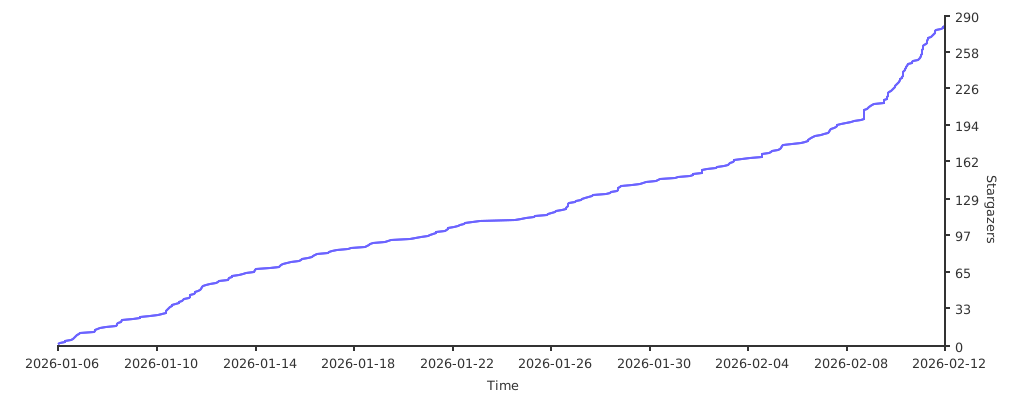
📊 Star Chart
How to Contribute
- Fork the repository
- Create your feature branch (
git checkout -b feature/amazing-feature) - Commit your changes (
git commit -m 'Add amazing feature') - Push to the branch (
git push origin feature/amazing-feature) - Open a Pull Request
See CONTRIBUTING.md for detailed guidelines.
🙏 Acknowledgments
Special thanks to CLIProxyAPI - the original Go implementation that inspired this JavaScript port.
📄 License
MIT License - see LICENSE for details.